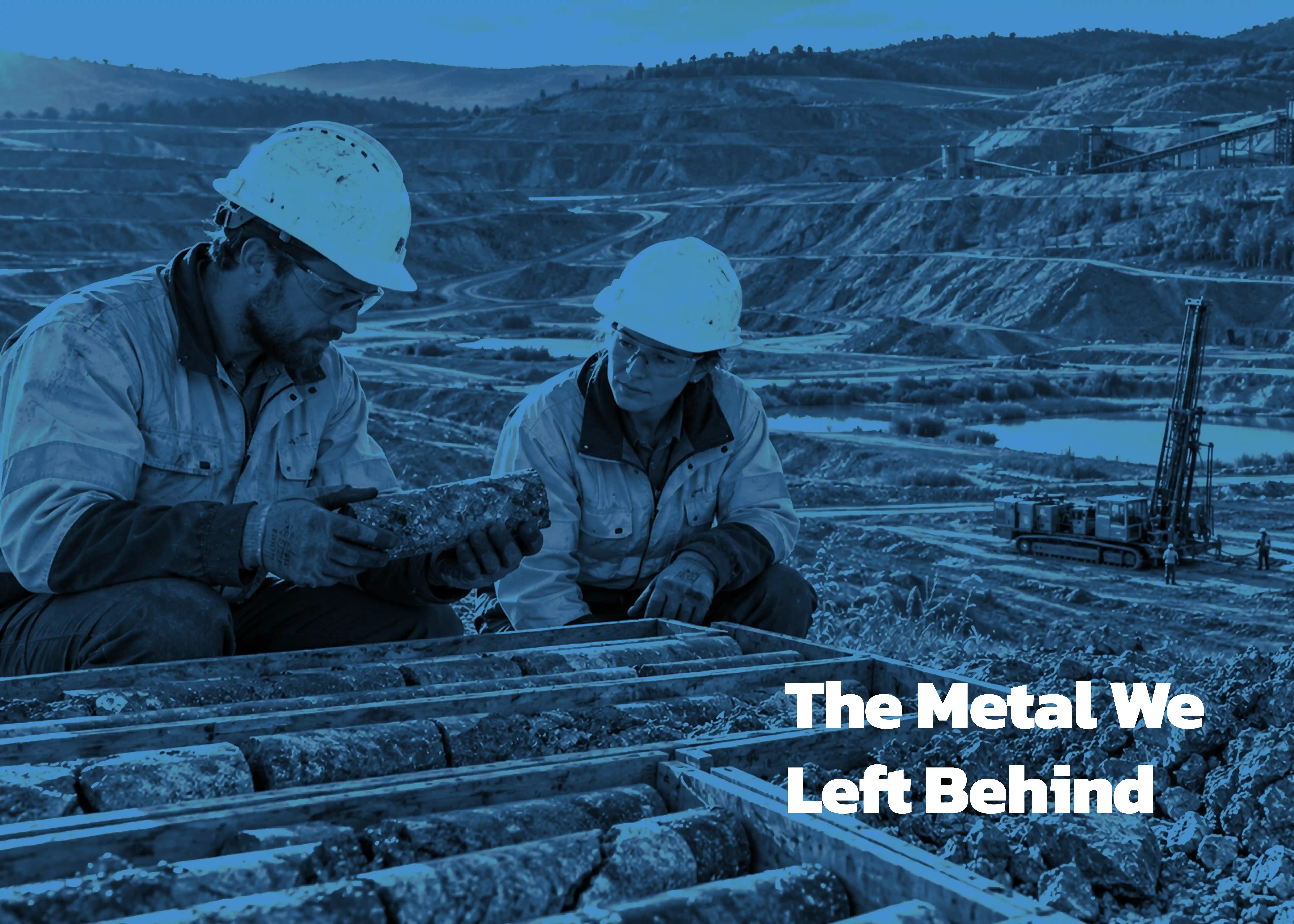
Somewhere in the sludge of a decommissioned tailings pond sits a strange kind of wealth: metal that was mined once, thrown away, and has since become more valuable than the day it was buried.
That paradox is driving a quiet rush back to old mine sites. As electric vehicles, grid-scale batteries and renewables pull harder on the world's cobalt, nickel and copper supply, engineers are asking whether legacy waste — tailings, flooded pits, slag heaps behind closed mines — might be a mineral deposit in disguise.
The math is straightforward. The International Energy Agency's 2025 outlook puts nickel and cobalt demand growth at 6 to 8 percent a year, driven almost entirely by batteries and electrification; under current policy trajectories, nickel demand could double by 2040. Copper, the workhorse metal of the transition, faces a starker problem — the IEA projects mined supply could fall short of 2035 demand by roughly 30 percent.
Cobalt makes the case most vividly. The Democratic Republic of Congo supplies more than three-quarters of the world's mined cobalt, and in 2025 that concentration turned into chaos: an export ban, then a quota system, sent prices up roughly 330 percent in a single year. For manufacturers watching one country set the price of their batteries, a tailings pond in Ontario or Nevada starts to look like a hedge.
Ore that got away
Tailings hold recoverable metal for reasons that seem, in retrospect, almost apologetic. Mid-century flotation circuits were blunt instruments, leaving copper and cobalt behind at grades that would be economic today. Cobalt in particular was rarely the target — it rides along with copper and nickel ore, and older operations often had no process built to catch it. What was waste rock under 1960s technology and prices can be ore under today's hydrometallurgy and today's demand.
The proof of concept already exists at industrial scale. Near Kolwezi in the DRC, Eurasian Resources Group's Metalkol operation reprocesses century-old tailings — 112 million tonnes grading 1.49 percent copper and 0.32 percent cobalt, comparable to many primary deposits — and has become the world's fourth-largest cobalt producer since 2018. In Sudbury, Ontario, researchers are piloting bioleaching to pull nickel and cobalt from tailings over a century old, in a district some now estimate holds billions of dollars in residual metal. In Queensland, Sibanye-Stillwater's Century operation reprocesses old zinc tailings so effectively it cut the site's closure liability by more than three-quarters.
Reading the water
Deciding whether a tailings site is a resource or just a liability comes down to chemistry that has to be measured, not assumed: grade, whether the metal sits in sulfide or oxide form, how fine the particles are, how far weathering has already redistributed metal through the pile.
Water is where much of that chemistry becomes visible. Dissolved metal in pore water and pit lakes is, in effect, a running readout of what's geochemically mobile underground — the same signal that tells a closure team how much cobalt or copper is leaching also tells a metallurgist what might be recoverable. At Montana's Berkeley Pit, researchers are testing whether rare earths and other critical metals can be precipitated directly out of water already being treated for acid drainage, turning an environmental cost center into a possible byproduct stream. The dataset built to manage a site's water is, increasingly, the same dataset needed to evaluate its mineral potential.
Why now
Policy has caught up with the chemistry. The EU's Critical Raw Materials Act now requires assessing recovery potential from mine waste at old and active sites alike. In the US, production tax credits under the Inflation Reduction Act extend to critical minerals recovered from tailings. Canada's critical minerals strategy treats secondary sources as core to its supply ambitions. Reprocessing also carries an environmental case new mining can't match: the rock is already dug up and ground down, and stripping sulfides out of an old impoundment can shrink the acid-drainage burden a site would otherwise carry for decades.
The catch
None of this is automatic. Grades below a certain threshold don't cover processing costs. Fine, complex, intergrown minerals resist cheap extraction. Cobalt prices that triple can also fall by half. The billion-dollar figures that circulate about old mining districts are inventories, not reserves — the gap between them closes only through drilling, sampling and metallurgical testing done properly, the unglamorous work behind every recovery project that actually works.
That's the real story of critical minerals at closure sites: not a treasure hunt, but a characterization problem. The tailings ponds and pit lakes that once marked the end of a mine's working life are increasingly where its next chapter gets decided — one water sample at a time.