Across the global mining industry, water management is entering a new regulatory era. Governments are tightening discharge standards, expanding monitoring requirements, and demanding stronger evidence that mining operations are protecting surrounding ecosystems.
For mining companies, these changes affect more than environmental reporting. They influence how water treatment systems are designed, how monitoring programs are structured, and how compliance risks are managed throughout the life of a mine.
What once centered primarily on meeting numeric discharge limits is evolving into a broader expectation: mines must now demonstrate that their water management systems work not only at the point of discharge, but across the receiving environment. This shift is visible across several major mining jurisdictions, including Canada, Chile, Brazil, South Africa, and Kazakhstan, where regulators are strengthening environmental oversight of mine water.
The trajectory is clear. Water regulation is becoming more stringent, more data-driven, and more focused on long-term environmental outcomes.
A global tightening of mine water standards
Regulatory frameworks vary from country to country, but the overall trend toward stronger water protection is widely shared.
In Canada, metal and diamond mines are governed by the Metal and Diamond Mining Effluent Regulations (MDMER) under the Fisheries Act. These rules establish national limits for contaminants such as arsenic, copper, cyanide, lead, nickel, zinc, and suspended solids. Canada also requires Environmental Effects Monitoring, a program designed to detect whether mine discharges are affecting fish populations or aquatic ecosystems downstream.
In Chile, where mining is central to the national economy, wastewater discharge is regulated through environmental standards such as Supreme Decree No. 90, which governs discharges to surface waters. Mining operators must demonstrate that treated water released to rivers or coastal environments meets strict pollutant limits intended to protect aquatic life.
Brazil regulates effluent discharge through a framework built around CONAMA Resolution 430/2011, which establishes national standards for wastewater discharge. These requirements interact with water classification systems that define acceptable pollutant levels depending on the environmental sensitivity and use of the receiving water body.
In South Africa, the National Water Act governs water use and discharge associated with mining activities. Mines typically require Water Use Licences, which specify discharge conditions, monitoring obligations, and environmental safeguards intended to protect regional water resources.
Meanwhile, Kazakhstan, an increasingly important mining jurisdiction, has been strengthening environmental oversight through updated environmental and water legislation aimed at improving industrial water management and environmental protection.
While the regulatory mechanisms differ—from federal effluent regulations in Canada to water licensing frameworks in South Africa—the direction is consistent. Regulators are demanding stronger control over mine water discharge and more comprehensive monitoring of environmental impacts.
From simple compliance to environmental accountability
For much of the twentieth century, mine water regulation often focused on relatively straightforward indicators such as acidity, suspended solids, and a limited number of metals.
Today, regulators are expanding the scope of water quality oversight. Greater attention is being paid to contaminants such as selenium, nitrates, dissolved metals, and salinity, as well as to the cumulative effects of discharges on downstream ecosystems.
As a result, mining companies are increasingly required to invest in more advanced water treatment technologies and to generate larger volumes of environmental monitoring data. Regulators now expect operators not only to meet permit limits, but also to demonstrate that discharges are not degrading surrounding water bodies.
This shift reflects a broader transformation in environmental governance. Compliance is no longer defined solely by meeting a number on a permit; it increasingly depends on evidence that ecological systems remain protected.
New monitoring tools for a stricter regulatory landscape
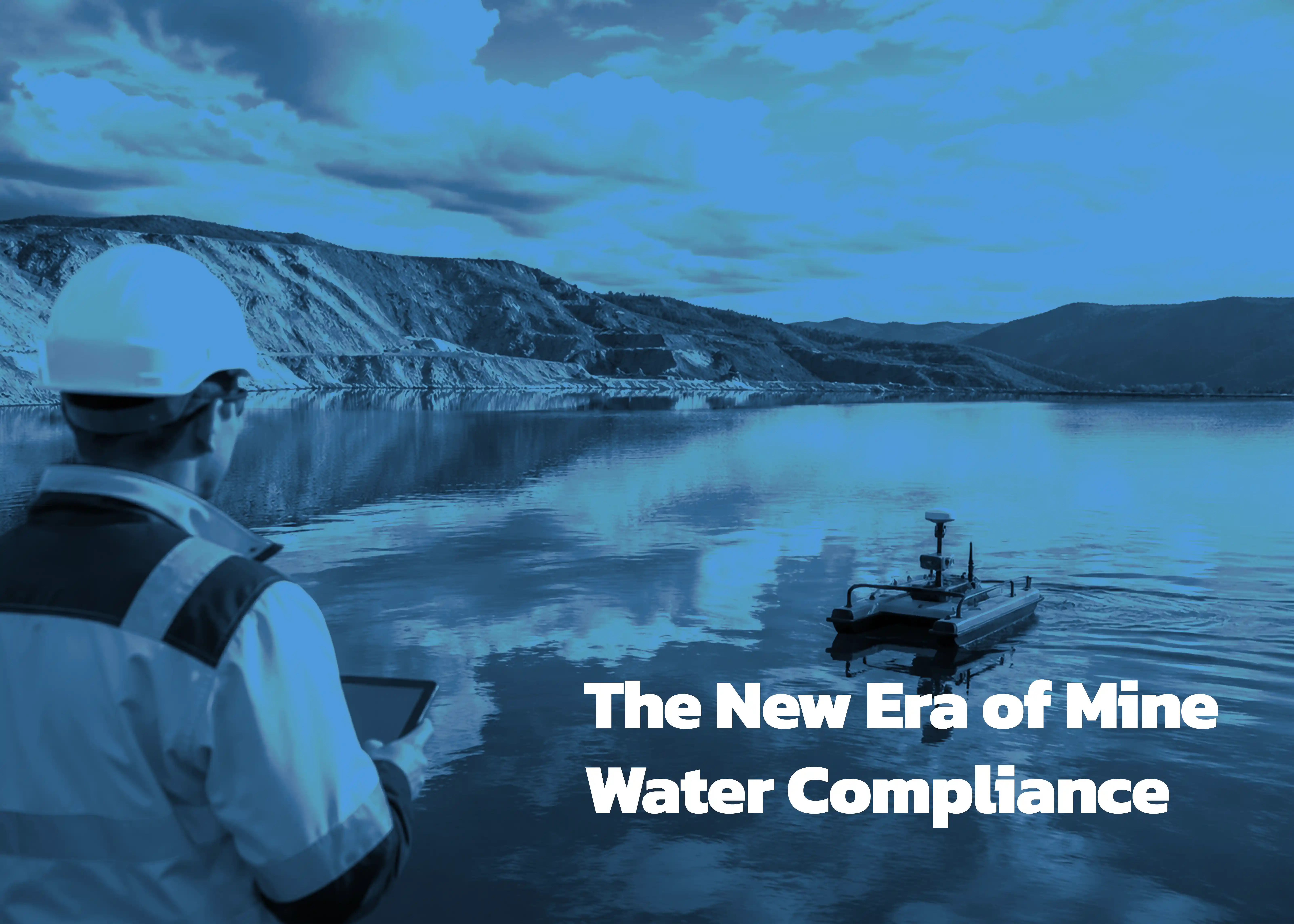
As regulatory expectations evolve, monitoring technologies are also changing. One emerging approach involves the use of unmanned surface vehicles (USVs)—autonomous boats equipped with environmental sensors—to improve water quality monitoring in mining environments.
As regulators demand more frequent monitoring and more spatially detailed environmental data, traditional sampling methods are often no longer sufficient on their own. In large tailings ponds, pit lakes, or receiving waters, water quality conditions can vary significantly across different areas, making single-point sampling an incomplete representation of actual conditions.
Autonomous monitoring boats can navigate across water surfaces and collect measurements continuously across multiple locations. Equipped with sensors capable of measuring parameters such as pH, dissolved oxygen, turbidity, conductivity, temperature, and oxidation-reduction potential, these systems can generate detailed spatial profiles of water conditions.
For mining operators, this approach offers several practical advantages.
First, it enables earlier detection of water quality changes, allowing operators to identify potential compliance risks before they result in regulatory exceedances.
Second, it improves environmental understanding within complex water bodies, such as tailings ponds where mixing patterns or contaminant plumes may vary across the basin.
Third, autonomous monitoring reduces safety risks by limiting the need for personnel to collect samples in potentially hazardous areas near unstable shorelines or contaminated waters.
Finally, the higher resolution datasets produced by these systems strengthen regulatory reporting and environmental transparency, supporting more robust compliance documentation.
As regulatory frameworks increasingly emphasize data-driven environmental oversight, technologies that expand monitoring capabilities are becoming an important component of modern mine water management programs.
The direction of travel
Taken together, developments across major mining jurisdictions suggest that water regulation will continue to tighten in the coming decades. Public concern about water quality, combined with advances in environmental science and monitoring technology, is pushing regulators toward stronger oversight of industrial discharges.
For mining companies, adapting to this landscape will require more than incremental improvements. It will involve designing treatment systems capable of meeting evolving standards, expanding environmental monitoring programs, and integrating new technologies that provide clearer insight into water quality dynamics.
In this context, effective water management is no longer simply a regulatory requirement. For modern mining operations, the ability to monitor water quality accurately and continuously is becoming as important as the treatment systems themselves.